Research Group Synthesis
Reviewed: 2026-05-06
Introduction
Software engineering is the core engineering discipline behind almost every product and service in modern industry. Cars, telecom networks, medical devices, manufacturing platforms, energy systems, public services, financial systems, marine systems, games and entertainment are all software-intensive products and services (SIPS) — products and services in which software is not a component but the medium through which value is created, delivered, and evolved. The Software Engineering Research Lab (SERL) at Blekinge Institute of Technology studies how SIPS are conceived, designed, built, validated, deployed, and maintained over their lifespan. Our work is empirical, applied, and built around long-term collaboration with industry partners across telecom, automotive, defence, fintech, manufacturing, entertainment and many other sectors.
The research portfolio is currently shaped by two transformations that affect the entire discipline: the use of generative AI as an instrument of engineering work (AI for Software Engineering, AI4SE), and the engineering of products and services that contain AI components (Software Engineering for AI, SE4AI). Around these two directions, we maintain long-running research lines on continuous delivery, requirements and testing, security and operations, and how software is developed at scale.
AI for Software Engineering (AI4SE)
AI4SE concerns how the practices and principles of software engineering shift when engineers use generative AI as an instrument of their work — to write code, generate tests, refine requirements, explore design alternatives, document systems, support reviews, and analyse defects. Each use is plausible; each carries risks the discipline does not yet fully understand. We study these uses empirically, in real industrial settings, with the aim of distinguishing genuine improvement from acceleration of existing practice and from new failure modes that traditional quality assurance does not catch.
Software Engineering for AI-based systems (SE4AI)
SE4AI concerns how the engineering of products and services adapts when the systems being built contain AI components. AI components are non-deterministic, depend on data distributions that drift, can fail in ways that traditional testing does not catch, and raise unfamiliar questions about safety, security, traceability, regulatory compliance, and maintenance over time. The systems containing them are no longer fully specifiable in advance, no longer fully testable through coverage-based methods, and no longer fully predictable in long-term behavior. SE4AI is not the engineering of AI itself; it is the engineering of products and services in which AI sits as one component among many.
Both AI4SE and SE4AI permeate all the engineering areas we work with - below an overview of current research areas within Software Engineering.
Continuous Delivery, Reuse, and Quality
Our research on continuous software engineering takes a cost-benefit perspective on continuous integration and continuous delivery: which benefits are actually attainable in industrial practice, what investments and risks they require, and which contextual parameters determine whether the investment pays off. We study strategic reuse as an organizational capability rather than a library of components — how InnerSource practices, microservice ecosystems, CI/CD pipelines, and decision models for component selection sustain reuse at industrial scale. Our quality research connects internal-quality measures to maintainability, reliability, and long-term evolution cost, including the role of code review and how review knowledge propagates across teams. We also work significantly with efficiency and effectiveness as quality aspects, and value-driven engineering: how well and efficiently does a SIPS solve a problem for the user or user’s organization?
Requirements, Testing, and Traceability
Our requirements engineering research develops the empirical foundations for what makes requirements fit for purpose, building toward measurement frameworks that connect requirements quality to its impact on subsequent development activities. Substantial work addresses regulatory compliance as a requirements-level concern. Compliance automation, impact on generative components and compliance, the cost and impact of compliance, automated verification and validation in relation to compliance, and automated extraction of compliance requirements from regulatory artifacts are but a few directions.
Our verification and validation research (e.g. testing) focuses on the long-running challenge of GUI test automation: similarity-based and LLM-supported web element localization, augmented testing for manual GUI regression, code-review guidelines, and on traceability — including taxonomic trace links and a systematic mapping of auxiliary artefacts in requirements traceability. Significant resources are going into new methods, models, principles and practices for quality assurance of (Gen)AI-intensive SIPS, that is how do we quality assure generative components as part of a system without limiting the capacity and flexibility it offers.
Security, Privacy, and Operations
Our work treats security and privacy as routine engineering activities rather than separate disciplines applied late. Software security maturity is investigated empirically in industrial settings — for example, evaluating the OWASP Software Assurance Maturity Model. Threat modelling for AI-intensive systems is a growing focus where we for example have developed a Machine Learning Security Maturity Model and recent work on threat modelling for LLM-integrated applications. Privacy is studied as an engineering activity rather than a compliance afterthought, including work on Privacy by Design and GDPR alignment with software specifications. For operations, we study how engineering organisations build and maintain confidence in CI/CD pipelines, including non-functional testing in CI environments and the asset structure that supports development and operations of software-intensive products and services.
Ways of Working at Scale
Our research on hybrid and post-pandemic work characterises how performance, productivity, and team functioning evolve when on-site presence is partial — the conditions under which hybrid arrangements actually work, and the practices that sustain coordination when they do not. We have studied psychological safety in remote settings, and the conditions that draw engineers back to physical workplaces). At organisational scale, we study decentralised decision-making, communities of practice, ownership and clone governance in shared codebases, and the alignment between technical architecture and organisational structure — including recent work on the dynamics of cross-organisational software collaboration. The shared theme across this work is making organisational and architectural choices visible, measurable, and revisable. We also have a long-tradition of lean/agile work research and value-based engineering practices, where value measurement and outcomes are evidence-driven.
Current research directions - and immediate future
Two focuses currently shape our research agenda. First, AI4SE: where we look at how AI affects the principles of Software Engineering. Second, SE4AI, where we look at how the engineering of products and services adapt whit AI build-in. All process areas (traditional SWEBOK), from requirements, design, architecture, coding, verification and validation, evolution, maintenance, and more need to be rethought! If we take coding/development as an example. We will use GenAI to improve, automate, support and speed-up coding (AI4SE) – but what are the implications of this this? GenAI introduces new types of errors, new types of limitations born from challenges with context windows, where do we draw the line between human and machine work and responsibility, what can humans do when they are not writing all code that adds value beyond what we do today. Looking at the other perspective. If GenAI augments a human developer to code, what type of architectures do we need going forward that takes advantage of the capacity, but takes GenAI limitations into consideration, and how do we handle non-functional (quality aspects) such as usability and security. All of this and much more promises a bright future for Software Engineering and Software Engineering research!
A special note: How we work with partners
We do not work like traditional academic researchers. Our research does not start at a desk, get tested on toy examples, and finish in a publication that no industry partner has any way to use. It starts with real industrial problems, develops candidate solutions in cooperation with the people who will use them, and validates those solutions step by step in the settings where they have to work. The figure below shows the cycle of co-production developed as early as 2006 but has evolved over the years (Gorschek, Garre, Larsson and Wohlin (IEEE Software, 2006).
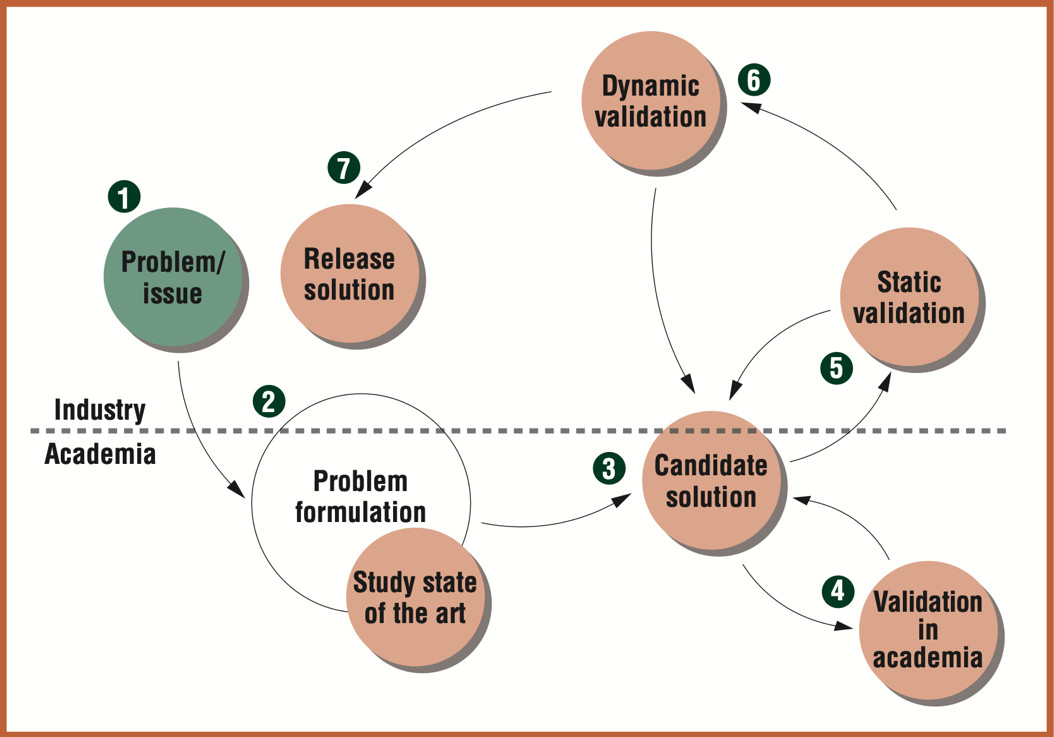
Each research project moves through these seven steps. It begins on the industry side, with a real problem (1) identified through on-site presence and observation — not a topic chosen because it suits the literature. The research agenda crosses into academia, where the question is formulated rigorously and the relevant state of the art is studied (2), normally in cooperation with industrial champions who help us understand the domain. We also separate the symptoms from the actual problem (root cause). A candidate solution (3) is then designed jointly with industry — drawing on existing research where possible, and adding new contributions where needed. The solution is first validated in academia (4) through controlled experiments and lab studies; this catches obvious flaws cheaply, before any industrial resources are committed. It then returns to the industry side for static validation (5) — widespread presentation to practitioners and management through seminars and interviews, gathering feedback and shaping the solution further. Dynamic validation (6) follows: piloting in a real industrial project, with real engineers, on real artefacts, but with limited scope so risk stays manageable. Only after the solution survives all this is it released (7), with the tailoring, training, and tool support that make adoption possible. The key is that we as researchers have to measure the benefit of a “solution” in an objective way. This is needed for publications and research, but is a huge benefit for partners as it gives transparent evidence before investment into the new solution. We do not sell solutions – we prove them. This is the SERL way.